Countries
90+
Countries worldwide with experiences powered by AnyRoad.
Seven years at AnyRoad, growing the design surface area from a single event-management product into a multi-product platform powering branded experiences for global customers. Joined as a Senior Product Designer in 2019. Now Director of Design, leading the work across every surface AnyRoad ships: operations, guest experience, analytics, field activations, and premium loyalty.
When I joined AnyRoad in 2019 as a Senior Product Designer, the company was a single-product event tool helping a small set of customers run tours and tastings. The design challenge was straightforward: make the operator's job easier. But the company's thesis was larger. Brand experiences create loyal customers, and the data they produce can prove it. That thesis is what I spent seven years designing toward.
Over that time, I led design as a single event tool grew into an entire platform. Four product areas, dozens of surfaces. Hundreds of customers across 90+ countries. Industries from spirits and brewing to CPG and retail. Brands from Diageo and Anheuser-Busch to Ben & Jerry's, Sierra Nevada, and Just Egg. Each surface added a new design problem: how do you make an operator's workflow fast enough to run a live venue? How do you capture guest data without making the guest feel like a target? How do you turn 15 million data points into something an operator acts on Monday morning?
This case is the platform-level view: the design decisions across every surface I've shaped. Each spotlight below is one part of that chain.
"The hardest design problem wasn't any single screen. It was making four product areas feel like one coherent system."
Each product area answers a different question in the lifecycle of a branded experience. Together they compose into a single operating system. Every spotlight below is a surface I've shaped.
The operational backbone: scheduling, capacity planning, staff tools, walk-up bookings, and revenue tracking for thousands of experiences a year.
Read deep dive →Every touchpoint where guest data enters the platform: the branded booking flow, FullView for onsite multi-guest capture, AnyRoad Live for field activations, and the post-experience feedback survey that closes the loop.
Read spotlight →The data product layer. Five distinct surfaces (Question Builder, Explorer, Pinpoint AI, Insights, Industry Benchmarks) that turn raw guest data into operational understanding.
Read deep dive →The premium membership division: turn-key membership programs and bottle subscriptions for spirits and CPG brands, built on everything the platform learned about each guest.
Read spotlight →The platform map shows four product areas. But each area is made of many distinct surfaces: screens, flows, tools, and modules that I've designed, shipped, and iterated on over seven years. This is what 50+ features actually looks like when you open it up.
Experience Manager is the surface AnyRoad's operators live in every day. Brand-home staff, distillery managers, retail event leads. They use it to schedule, staff, sell tickets, run the day, and prove the value of a season afterward.
Before this product matured, brand-home teams stitched together booking widgets, spreadsheets, manual headcount, and disconnected POS. The redesign pulled those operations into a single workspace: a structured creation flow for getting experiences from blank to live, a walk-up flow that handles whatever shows up, a booking lifecycle that surfaces what the operator can act on, and guest data captured for everyone in the party.
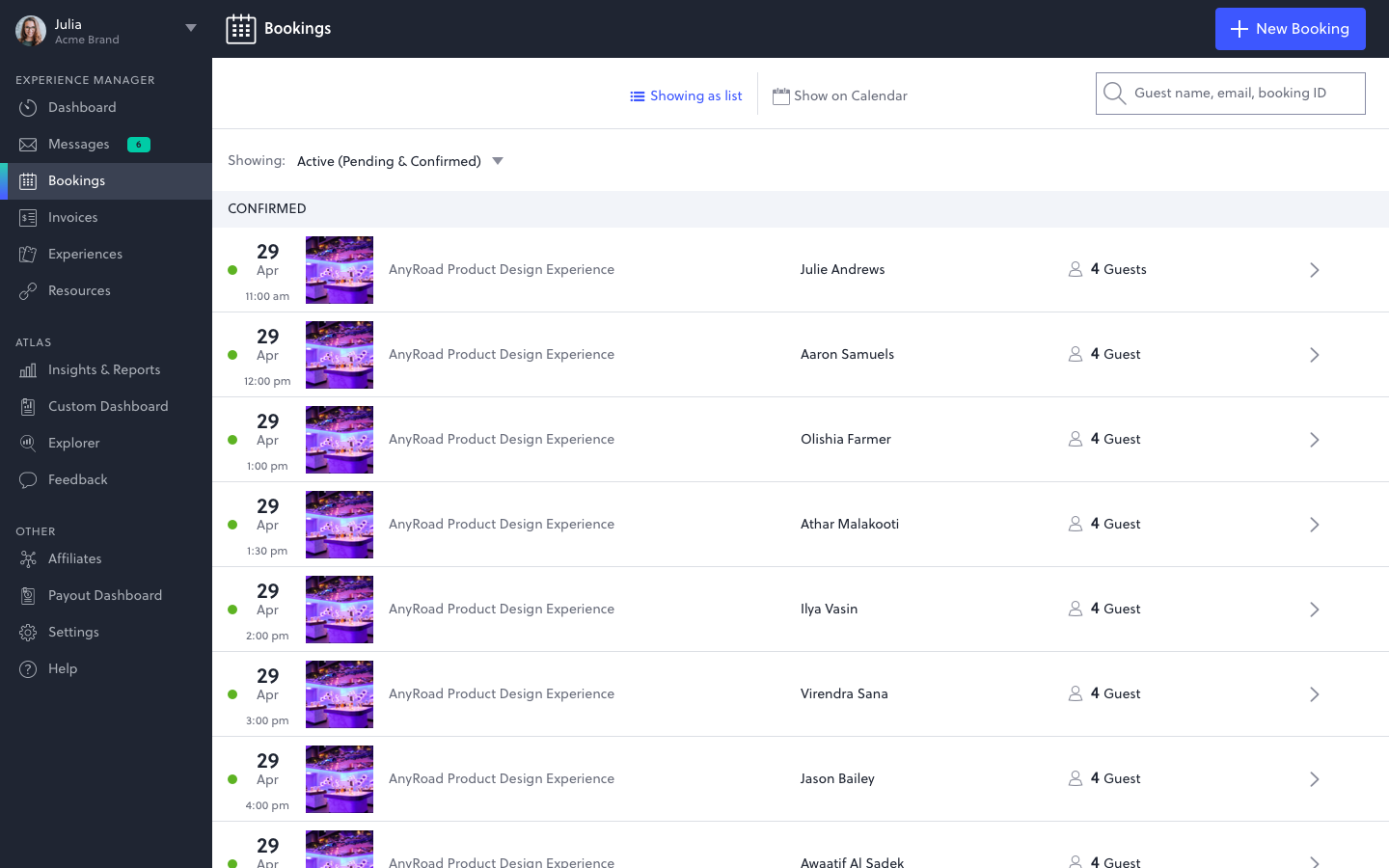
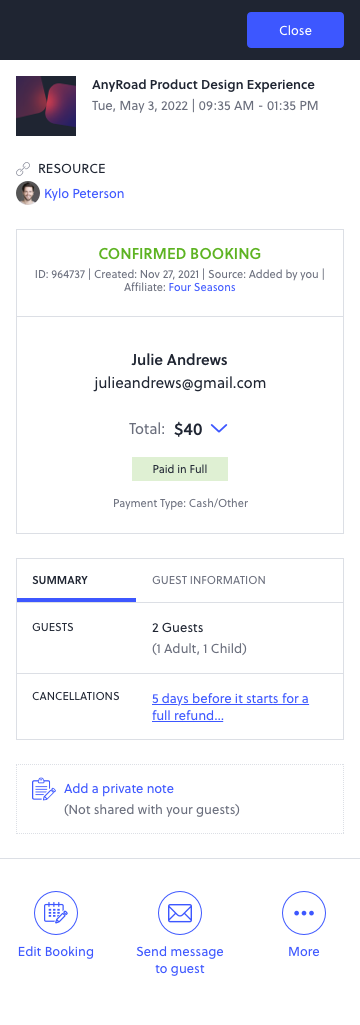
The operator runs the program. But capturing the guest data that makes everything else work happens across four touchpoints, each with its own design problem: the scheduled booking flow, the onsite check-in, the field activation with no booking step, and the post-experience survey that closes the loop.
Getting guest data into the platform is the hinge point of the whole system. Everything Atlas surfaces, everything Lifetime Loyalty acts on, starts here. But "guest data capture" isn't one surface. It's four, each with completely different constraints.
Every booking, check-in, and survey response flows into Atlas. The design challenge: turn 15 million annual data points into something an operator actually reads and acts on, without building a BI tool that only analysts understand.
Atlas Insights is the analytics surface AnyRoad's customers use to turn raw guest data into operational understanding. Five surfaces that close the loop from collecting feedback to acting on it: Question Builder, Explorer, Pinpoint AI, Insights, and Industry Benchmarks.
This is the most-detailed surface I've shipped at AnyRoad, and the one with a named, public customer proof point. Diageo's Johnnie Walker Princes Street publicly attributes a 16-point post-visit NPS lift to Explorer, Pinpoint, and Industry Benchmarks on their flagship whisky tour. The deep dive on each surface lives on its own page.
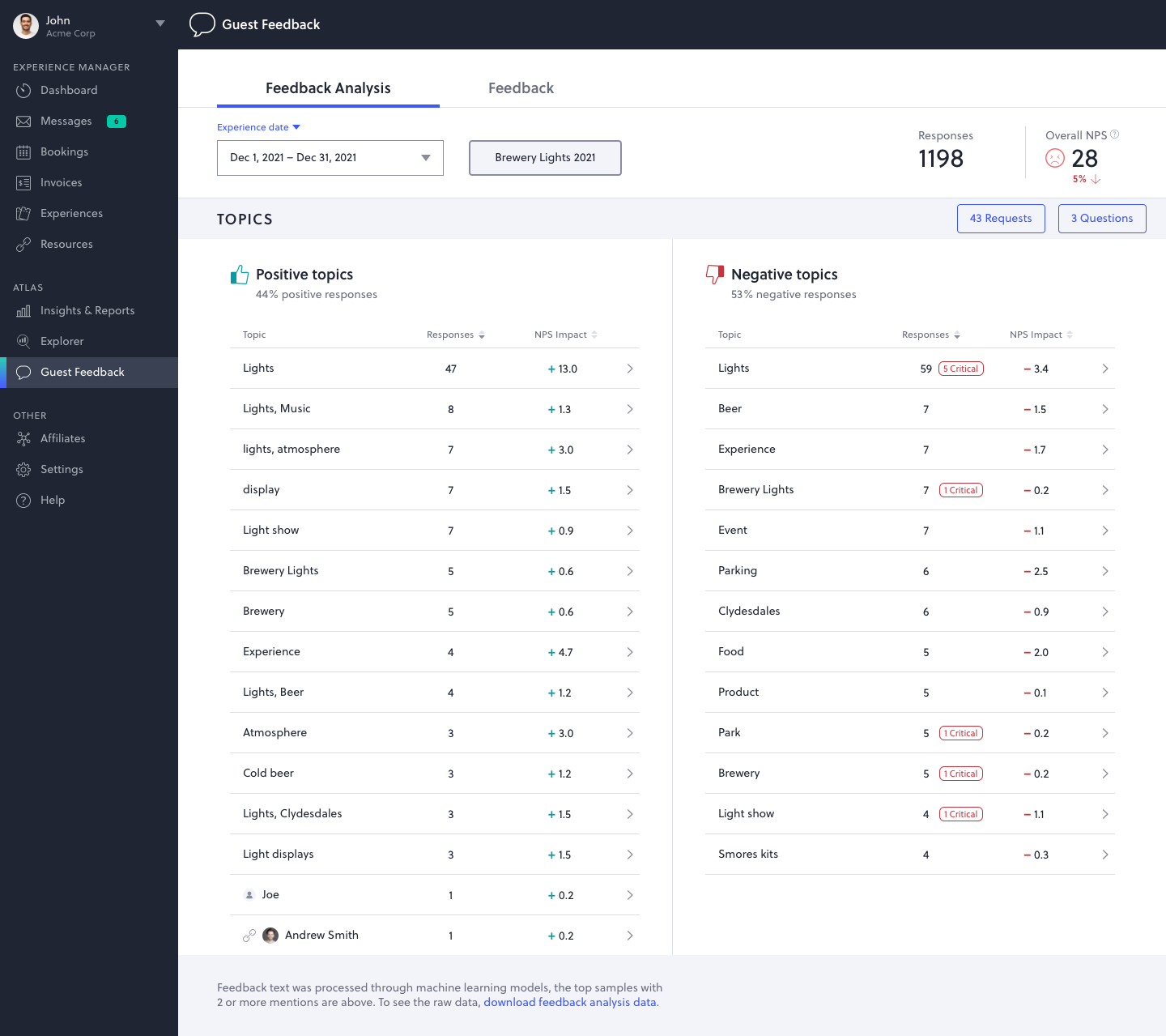
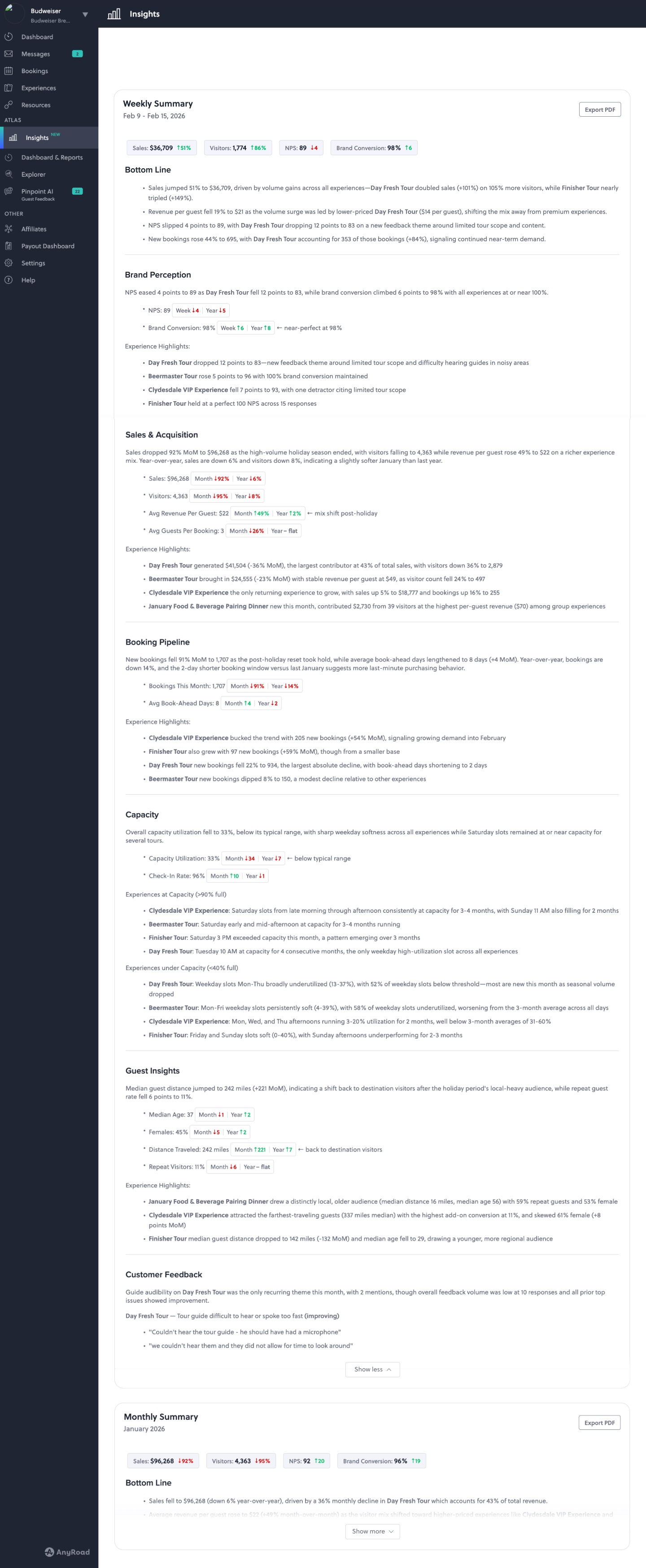
"With AnyRoad, we are able to measure NPS, Brand Conversion, and more, providing us with solid data that shows the positive impact the JWPS experience is having on our guests. We can then follow up with them to create a lifelong relationship with our brand."
This is where the loop closes. Everything the platform learned about a guest (what they booked, how they rated it, what brought them back) becomes the foundation for a membership program designed to keep them. The full story is in the linked cases below.
Lifetime Loyalty is AnyRoad's premium membership division. Where the rest of the platform turns one visit into measurable data, Lifetime Loyalty turns measurable data into recurring revenue. Membership programs, bottle subscriptions, member-only experiences, partner-driven launches.
This branch grew big enough to warrant its own case studies. The parent ecosystem case walks the strategy, the system, and the operating model across 20+ programs. The LL12 x LALIGA case walks a single flagship partnership in detail. Both are linked below.
Across seven years and four product areas, the platform-design decision underneath everything was that the surfaces had to compose, not just coexist. A booking captured in Guest Experience populates the dashboard in Experience Manager and the segment view in Explorer. A topic surfaced in Pinpoint appears inside Insights. A guest from a Live activation lands in the same customer record an LTL membership program will eventually pull from.
That meant we couldn't design surfaces as separate features. They had to be designed against a shared mental model: the same customer, the same segment, the same experience taxonomy. And against a shared interaction grammar so an operator who learned one surface could read all of them.
The platform's surface area grew from one product to four distinct areas. The design org grew with it. Becoming Director of Design in 2023 changed the unit of work from individual screens to the people, systems, and rituals that make screens get made.
From 2019 to 2023 I shipped the work myself, learning the platform, the customers, and the operating model from inside. From 2023 forward I've focused on building the design organization that ships it. Hiring, mentoring, design system stewardship, design culture, and the harder-to-see work of making sure the right decisions get made by the right people.
Below are the four pillars I lead the team against. Each one is a function of the platform getting bigger without the craft getting thinner.
The bar I hire against is straightforward: can this designer hold a high standard for craft, make decisions when the answer isn't obvious, and care about the people they work with. Resumes don't tell me that. Portfolio walkthroughs and a real conversation do.
The work that compounds isn't a set of files I touched. It's the team's ability to make the same call I would, without me. Mentorship inside my team is mostly about why a decision was made, what was considered and rejected, and how to argue for the better answer.
As the platform grew from one product to four distinct areas, the design system had to absorb new pattern needs (data-dense tables, mobile field tools, member-facing branded surfaces) without splintering into incompatible regional dialects. The pattern work is invisible when it succeeds.
The teams I want to be on are honest about the work and generous about the people. I lead critique that pushes hard on the design and stays soft on the designer. Care, craft, and clarity, in that order.
— Platform-level outcomes per AnyRoad public reporting · Customer-specific outcomes in individual case studies
The seams I'm proudest of (the way a Pinpoint topic appears inside an Insights paragraph, the way a Live activation lands in the same customer record an LTL membership pulls from) couldn't have been designed without years of internal context. Knowing the customer, the operating model, the engineering constraints, the past decisions and the reasons they were made. Tenure is rarely fashionable in design careers, but it's where the most consequential work tends to live.
For five years the question was "what's the right thing to ship?" and I answered it myself. The last two years the question has been the same, but the answer has to come from the team. The shift wasn't from doing to managing. It was from being one decision-maker to building the conditions where many designers can make consistently good decisions in parallel.
Across four product areas and five years of platform expansion, the question I kept returning to was the same: what does a brand-home director actually do on a Monday morning? Designing against that question pulled the team out of feature-by-feature thinking and into a workflow we could measure end to end. It's also what kept the platform feeling like a platform, not a portfolio of products.